



Written by: Terje. H Nilsen
Bali is once again doing what Bali does best: attracting the world. January arrivals this year pushed close to 600,000 foreign visitors — up from roughly 530,000 the same month last year. The recovery narrative is over. We are now in the phase of recalibration.
But here is the question serious investors should ask: What do rising tourism numbers actually mean for property demand — and where is the smart capital moving?
1. Tourism Recovery Is Now Structural, Not Cyclical
Bali is no longer “recovering.” It is stabilizing at a high-volume baseline. Several structural shifts are visible:
▪ Longer average stays (especially European and Australian markets)
▪ Growth in remote workers and semi-residents
▪ Increasing family travel and wellness-focused tourism
▪ Strong hotel performance across mid- to high-end segments
Hotels are generally performing well, particularly branded and professionally managed properties. That tells us something important: demand is not disappearing — it is professionalizing. And when tourism professionalizes, property demand follows.
2. Demand Is Shifting — Not Exploding Everywhere
Tourism growth does not automatically mean every villa sells. Instead, we are seeing segmentation:
A. Canggu & Uluwatu: High Volume, High Competition
Occupancy can be strong — but so is supply. Margins depend heavily on:
▪ Operational structure
▪ Licensing readiness
▪ Zoning alignment
▪ Professional marketing
The days of “build anything and rent it” are over.
B. Ubud & Tabanan: Space, Nature, Eco Luxury
Medium- to high-end eco resorts and nature-focused villas are seeing increasing interest. Guests are actively seeking:
▪ Traditional Balinese architectural touches
▪ Authentic design over generic modern cubes
▪ Green space, airflow, water management
▪ Quiet zones with less congestion
Tabanan in particular is emerging as a high-end eco destination — not mass tourism, but curated living. This aligns strongly with sustainable lifestyle developments like Alassari and Nathaloka-type concepts, where quality and nature outweigh density.
3. Tourism Growth + Enforcement = Smarter Market
One major factor often ignored in headlines: Enforcement has increased.
Indonesia has not introduced radically new tourism laws — it is enforcing existing ones more consistently. This creates three immediate property effects:
1. OTA listings are being reviewed more strictly.
2. Short-term rental licensing gaps are being exposed.
3. Zoning misalignment becomes a financial risk, not just a technical detail.
Investors who rely purely on projected occupancy numbers — without regulatory clarity — may see revenue disruption. Tourism growth without compliance is fragile. Tourism growth with structure is powerful.
4. The Return of Traditional Design
Interestingly, data and agent experience show a renewed demand for:
▪ Joglo-style structures
▪ Open pavilions
▪ Natural stone and teak
▪ Authentic Balinese landscaping
Guests want Instagram moments — but they also want cultural immersion. Modern minimalism still sells, but the premium is increasingly attached to authenticity.
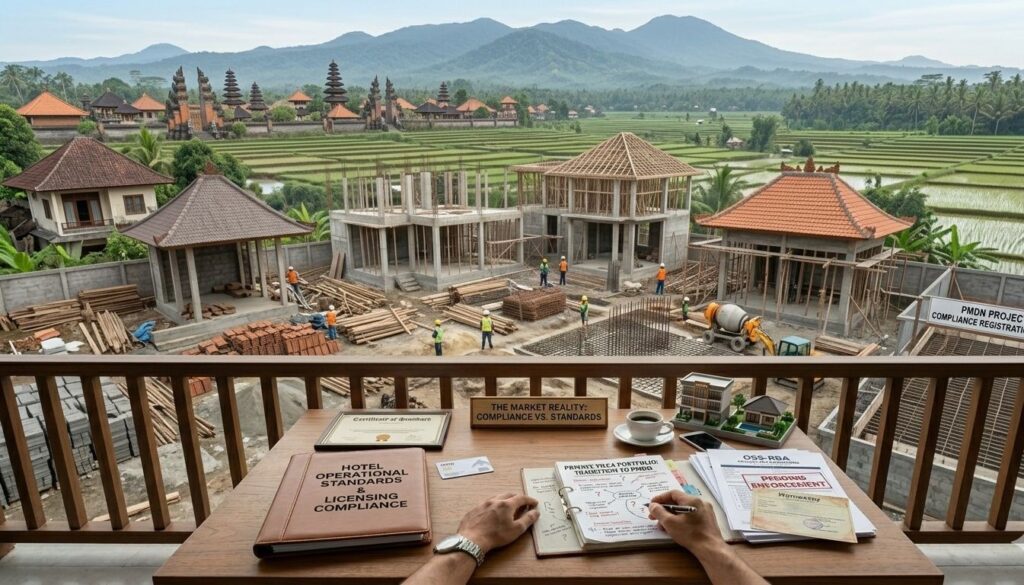
5. Hotels vs Private Villas: A Market Reality
Hotel performance remains strong because:
▪ They operate under clear licensing frameworks
▪ They have established operational standards
▪ They manage compliance centrally
Private villa investors must now compete on similar standards.
The market is maturing. Amateur operators are being filtered out. Professional operators — especially those structured properly under PT PMDN or compliant frameworks — are gaining stability.
6. Where Smart Capital Is Moving
Based on market conversations, transaction patterns, and operational realities, smart capital is moving toward:
▪ Medium-sized eco-resort concepts (10–25 units)
▪ Managed villa clusters
▪ Areas with clear zoning alignment
▪ Long-term lease security with proper legal structuring
▪ Developments with strong waste and water systems
The key driver is no longer only ROI. It is risk-adjusted ROI.
7. The Hidden Risk: Paper Compliance vs Operational Compliance
Many investors believe that:
▪ A lease agreement equals safety
▪ A nominee structure equals control
▪ A villa with guests equals legality
That gap between appearance and operational reality is where capital is lost. The investors who benefit most from rising tourism numbers are those who:
▪ Align KBLI correctly
▪ Secure zoning before construction
▪ Prepare OTA documentation properly
▪ Structure governance early
Tourism growth rewards structure.
8. What This Means for 2026–2027
If tourism arrivals continue at this pace:
▪ Land prices in secondary eco-zones will likely rise steadily
▪ Premium eco developments will command higher ADR
▪ Informal operators will struggle under enforcement
▪ Buyers’ agents and compliance advisors become more important
The Bali property market is not cooling. It is formalising. And formalisation does not reduce demand — it redistributes it.
Final Thought
Tourism numbers create headlines. Structure creates returns. Bali’s latest arrival figures confirm that global demand remains strong. But the property market no longer rewards speculation alone.
It rewards clarity.
It rewards compliance.
It rewards authenticity.
And increasingly — it rewards those who understand that tourism growth and regulatory structure now move together.