



Written by : Terje. H Nilsen
Hak Milik vs. Hak Pakai vs. Leasehold vs. PT PMA – What Foreign Investors Actually Own in Bali
Introduction: Let’s Address the Biggest Myth First
In today’s Bali property market — especially with increasing regulatory enforcement — the most dangerous phrase you will hear is: “This is basically freehold for foreigners.”
It isn’t. Under Indonesia’s Basic Agrarian Law No. 5 of 1960, foreigners cannot legally own freehold land (Hak Milik) in their personal name.
That right is reserved strictly for Indonesian citizens. So what can a foreign investor legally own or control?
Quite a lot — if structured correctly. In practice, foreign ownership in Indonesia happens through a framework of:
▪ Hak Pakai (Right to Use)
▪ Hak Sewa (Leasehold)
▪ PT PMA structures holding HGB
▪ Lease-based ownership with corporate or management overlays
And the right structure depends entirely on:
▪ Whether you live in Indonesia
▪ Whether you intend to rent
▪ Number of units
▪ Commercial vs lifestyle use
▪ Investment scale
▪ Licensing pathway (especially post-2025 enforcement)
1. Hak Milik (Freehold Ownership)
Hak Milik is Indonesia’s strongest land title — full ownership with no time limitation. But:
▪ Only Indonesian citizens may hold Hak Milik title.
▪ Foreign individuals and foreign companies cannot hold Hak Milik directly.
This is where nominee structures historically came in — and this is where we now see the highest enforcement risk in Bali today. As we have already pointed out often from Seven Stones discussions:
Paper compliance often collapses during audits or operational licensing — not at purchase. Nominee-held Hak Milik is the clearest example of that.
2. Hak Pakai (Right to Use – Individual Foreign Ownership)
Hak Pakai is currently the only registered land title that a foreign individual may hold personally.
Requirements:
▪ Valid residency permit (KITAS / KITAP / Second Home Visa)
▪ Property used for residential purposes
▪ Zoning compliance
Duration:
▪ Initial: ±30 years
▪ Extension: 20 years
▪ Renewal: 30 years
▪ Total potential control: up to 80 years

Hak Pakai is ideal for:
▪ End-users
▪ Lifestyle buyers
▪ Long-term Bali residents
▪ One-unit ownership
But:
Hak Pakai does not automatically provide commercial rental rights. Meaning:
Short-term rental operations will still require:
▪ Business licensing
▪ Operational KBLI
▪ Often corporate structure
Which leads us to…
3. Leasehold Ownership (Hak Sewa)
Leasehold remains the most common entry-level structure for:
▪ One or two villa investments
▪ Lifestyle-plus-rental buyers
▪ Medium-term investors
Typical structure:
▪ 25–30 year lease
▪ Extension option
▪ Registered notarial agreement
Foreigners may legally lease land or buildings for this duration with possible renewal. Now here is where reality enters the conversation in 2026:
A leased villa may still be operated commercially — but increasingly only through a licensed entity. So while you may lease privately…
Operational licensing often requires:
▪ PT PMDN
▪ or PT PMA (depending on model)
This is why we now frequently see:
Lease-owned asset operated by a licensed management company, particularly for:
▪ One or two units
▪ Investors not wishing to run a full company
▪ Passive ownership models
4. PT PMA Structure (Foreign Investment Company)
For investors looking to:
▪ Rent legally
▪ Develop
▪ Hold multiple units
▪ Operate hospitality businesses
…the formal route is:
PT PMA holding HGB (Hak Guna Bangunan)
Through a PT PMA:
▪ Freehold (Hak Milik) land is converted to:
▪ HGB (Right to Build)
This allows the company to:
▪ Build
▪ Develop
▪ Rent
▪ Mortgage
▪ Sell
▪ Transfer title
HGB validity:
▪ 30 years
▪ Extendable 20 years
▪ Renewable 30 years
▪ Up to 80 years total
PT PMA ownership removes:
▪ Nominee risk
▪ Beneficial ownership conflicts
▪ Inheritance uncertainty
▪ Commercial licensing barriers
But requires:
▪ Investment plan (≈ IDR 10 billion)
▪ Paid-up capital (≈ IDR 2.5 billion)
▪ Ongoing OSS reporting and tax compliance
Which is why:
For smaller investors… A lease + licensed operator model may be more practical.
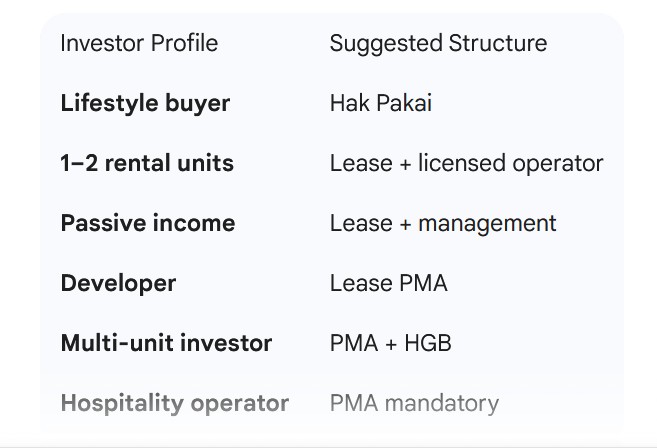
Choosing the Right Structure
The Bali Market Is Formalising
As we’ve discussed in earlier Seven Stones briefings:
Today’s regulatory environment is not introducing new ownership laws — it is simply enforcing existing ones.
Increasingly we see issues arise:
▪ During OSS licensing
▪ Audit
▪ Guest registration
▪ Tax reporting
▪ Zoning cross-checks
—not during purchase.
Which means: Structure now determines survivability later.
How Seven Stones Can Assist
With 20+ years in Bali’s development and brokerage ecosystem — from building villas, working with Ray White, Keller Williams and Harcourts, to becoming a full legal consultancy — Seven Stones provides:
▪ Ownership structuring
▪ PT PMA setup
▪ Lease-PMA hybrid models
▪ Zoning alignment
▪ Rental licensing pathways
▪ OSS compliance
▪ Management partnerships
▪ Due diligence
▪ Viable properties search
Each investment case differs — particularly today where:
In many instances PT PMA may not obtain short-term rental licensing directly.
Which is why: Structuring must now be done before acquisition —not after.