




Written by: Terje. H Nilsen
From First Visit to Fully Licensed Investment
Introduction: The Dream vs. The Structure
For many foreign investors, buying property in Bali begins with a dream: A peaceful villa. Rental income. A lifestyle investment surrounded by nature.
But in today’s Bali — particularly in 2026 — the journey from dream to legally operational property involves far more than selecting a beautiful plot of land or signing a lease agreement.
Over the past few years, we have seen increasing enforcement of zoning, licensing, and operational permits across Bali. Importantly, this is not due to new regulations — but the enforcement of existing ones that were widely misunderstood or simply ignored during the post-COVID investment boom.
At Seven Stones Indonesia, we have worked across the full lifecycle of property investment in Bali for over 20 years — from developing villas ourselves, to marketing with global brands like Ray White, Keller Williams, and Harcourts, to becoming one of Indonesia’s leading foreign investment consultancies.
Below is the actual journey foreign investors must navigate to move from land interest to a fully compliant, operational property.
Step 1: Understanding Your Ownership Options
Foreigners cannot own freehold land (Hak Milik) in Indonesia. Instead, common legal structures include:
▪ Leasehold Agreements
▪ Hak Pakai (Right to Use)
▪ PT PMA (Foreign-Owned Company) Land Ownership via HGB
▪ Lease through locally licensed operational PT PMDN
Each structure comes with different rights, timelines, and — critically — operational licensing implications.
A key point often missed: Ownership structure and operational structure are not the same thing.
Many investors believe holding land via a PT PMA automatically allows them to legally rent out short-term accommodation. In most cases, this is not correct.
A PT PMA often cannot obtain the required short-term rental license directly — meaning operational setup must be structured separately.
Step 2: Zoning – The Most Overlooked Risk
Before committing to any land purchase or lease, zoning must be verified against:
▪ Regional spatial planning (RDTR)
▪ Tourism designation
▪ Residential classification
▪ Mixed-use permissions
▪ Setback and building coefficient limits
Investors frequently rely on informal assurances such as: “This area is already full of villas — so zoning must be fine.”
However, enforcement is increasingly being applied based on formal spatial planning documentation rather than surrounding usage patterns. A villa built in the wrong zone may:
▪ Be denied a building permit (PBG)
▪ Fail to obtain an SLF (Function Certificate)
▪ Be ineligible for operational licensing
▪ Face future sanctions or operational closure
Step 2A: Formal Due Diligence Under PP 28/2025 (KKPR & Risk-Based Licensing)
Under Indonesia’s Risk-Based Licensing framework — most recently reinforced through Government Regulation No. 28 of 2025 (PP 28/2025) — property development eligibility is no longer determined solely by informal zoning review or even static RDTR documentation. Instead, investors must now undertake formal spatial utilisation approval through:
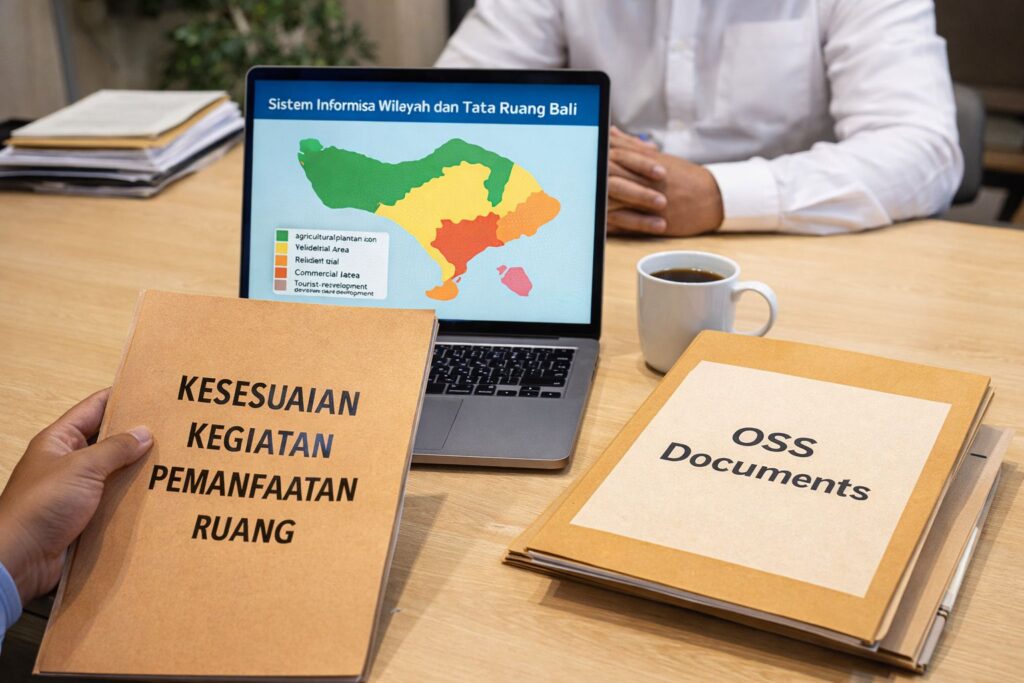
KKPR – Kesesuaian Kegiatan Pemanfaatan Ruang
KKPR confirms whether a proposed business activity — including villa development, tourism accommodation, or mixed-use hospitality — is legally permitted on a specific land parcel based on its intended operational use.
This is an essential step within the OSS licensing flow and precedes:
▪ Land acquisition or lease execution
▪ Development permit application (PBG)
▪ Environmental approvals
▪ Operational tourism licensing
Importantly:
A land plot may appear suitable for development under RDTR — but still fail KKPR approval based on the declared KBLI activity of the investor’s company. This is particularly relevant where:
▪ Tourism use is proposed in residential zones
▪ Commercial activity is conducted through an improperly classified PT PMA
▪ Infrastructure requirements (road access, wastewater, drainage) do not meet usage intensity
▪ Environmental thresholds are exceeded under medium or high-risk classification
PP 28/2025 Licensing Sequence (Simplified)
For income-generating property investments, the following regulatory pathway typically applies:
1. Business Activity Declaration via OSS (KBLI Selection)
2. KKPR Issuance – Spatial Use Conformity
3. Environmental Approval (if applicable)
4. PBG – Building Approval
5. SLF – Certificate of Function
6. Tourism Operational Licensing (TDUP / Risk-Based Permit)
Failure at the KKPR stage may prevent progression through the OSS system entirely — regardless of lease validity or corporate ownership structure.
Development feasibility is now assessed digitally at the licensing stage, not operationally after construction.
Step 3: Incorporating Your Investment Vehicle
If your goal is income-generating property, a PT PMA is often required to:
⮕ Enter land agreements
⮕ Conduct development
⮕ Structure financing
⮕ Manage long-term investment returns
The incorporation process includes:
▪ KBLI business classification selection
▪ Deed of Establishment
▪ Ministry of Law approval
▪ NIB issuance via OSS
▪ Tax registration
But incorporation alone does not make your property operationally compliant.
Step 4: Development & Construction Compliance
Development must align with:
✓ Approved spatial planning
✓ Environmental requirements
✓ Building design limitations
✓ Local architectural guidelines
✓ Wastewater and utility infrastructure
Required documentation includes:
▪ PBG (Building Approval)
▪ SLF (Certificate of Function)
▪ Environmental approvals (if applicable)
Failure at this stage may delay operational licensing — even if land ownership is secure.
Step 5: Operational Licensing – Where Most Investors Fail
This is where many otherwise well-structured investments encounter problems. Operating a property for short-term rental requires:
✓ Correct tourism KBLI classification
✓ Local licensing eligibility
✓ Alignment between ownership and operating entity
In many cases, the operational license must be obtained via a locally owned PT PMDN, even when land or buildings are held through a PT PMA. This often results in a dual-entity structure:
| Function | Entity |
| Ownership | PT PMA |
| Operations | PT PMDN |
This separation is now one of the most viable compliance pathways in Bali’s formalising tourism sector.
Step 6: Ongoing Compliance & Reporting
Post-construction, ongoing compliance includes:
▪ Tax reporting
▪ OSS updates
▪ Investment activity reporting (LKPM)
▪ Local tourism registration
▪ Workforce and wage compliance
Failure to maintain compliance can result in license suspension — even years after successful operation.
Conclusion: Structure Before Style
Bali remains one of the world’s most attractive lifestyle investment markets. But today’s market increasingly rewards investors who:
⮕ Align ownership with zoning
⮕ Obtain KKPR before committing to development
⮕ Separate operational licensing correctly
⮕ Incorporate compliant development pathways
⮕ Maintain post-construction reporting
Property investment here is no longer simply about land selection or design — but about legal architecture.
How Seven Stones Can Help
With over two decades of combined development, brokerage, and regulatory experience, Seven Stones Indonesia assists foreign investors across the full investment lifecycle:
✓ Investment structuring
✓ Zoning verification
✓ KKPR application
✓ PT PMA incorporation
✓ Development compliance
✓ Operational licensing pathways
✓ Ongoing reporting and governance
✓ Real estate search
Each investment scenario is unique — and must be structured accordingly to align with Indonesia’s evolving regulatory enforcement landscape.