




When it comes to property investment in Indonesia, licensing delays have always been a sticking point. Whether you’re securing a location permit, environmental approval, or building permit, the process could take weeks—or even months—longer than expected.
Now, that could be history.
On 5 June 2025, the Indonesian government rolled out Regulation 28/2025 on Risk-Based Business Licensing (Perizinan Berusaha Berbasis Risiko – PBBR).
This regulation replaces Regulation 5/2021, expands the licensing framework to cover 22 business sectors (up from 15), and—most importantly—introduces enforceable Service Level Agreements (SLAs) and a positive-fiction mechanism that could change the game for property developers, real estate agencies, and investors.
Why This Matters for Real Estate
Under the new framework, the real estate sector—including property development, brokerage, and supporting activities—must still comply with fundamental requirements such as:
✔️ KKPR – Conformity of Spatial Utilization Activities
✔️ PL – Environmental Approvals (AMDAL, UKL-UPL, or SPPL)
✔️ PBG & SLF – Building Approvals and Worthiness Certificates
The big difference is how fast these can now be processed—and what happens if the government misses the deadline.
The SLA Advantage
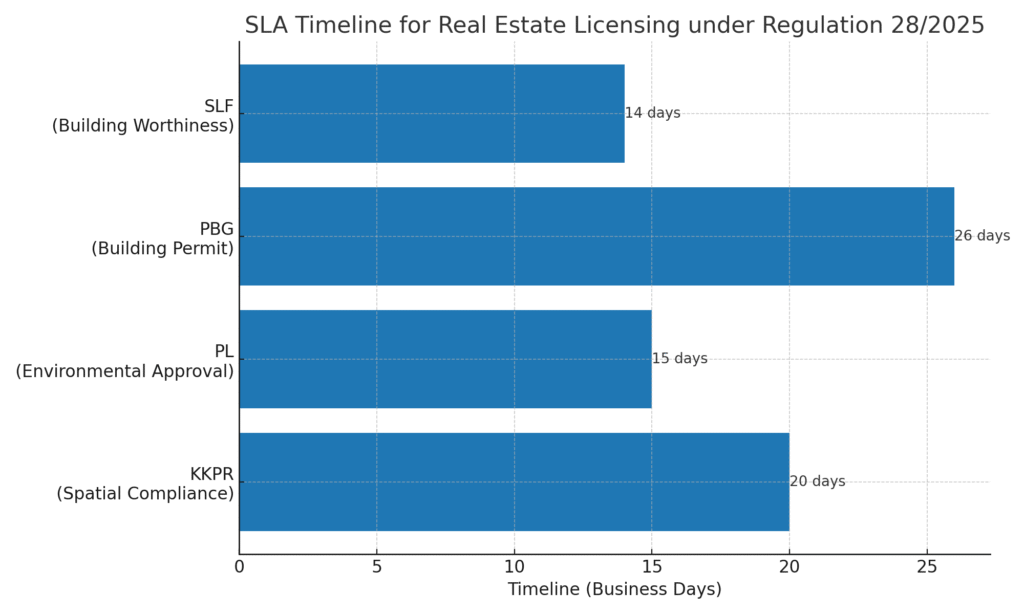
Regulation 28/2025 lays out clear, measurable deadlines for each licensing step:
📌 KKPR: Document review in 5 business days, full assessment in 20 business days
📌 PL (UKL-UPL): Review in 1–5 business days, automatic approval for low-risk cases
📌 PBG: Technical standards compliance review cut from 28 to 26 business days
📌 SLF: Issued within 1–2 weeks after inspection.
These SLAs are not just guidelines—they’re binding.
Positive-Fiction: Automatic Approvals
One of the most talked-about updates is the positive-fiction rule (fiktif positif). If your licensing application is complete, compliant, and submitted via the OSS system, but the authority fails to respond within the SLA timeframe, your approval is granted automatically.
BKPM has already published 258 KBLI codes covered by this rule, including many in construction, real estate, and property management.
Example: Building a Villa Development in Bali
Before: A developer might wait 6–8 months for KKPR, PL, and PBG approvals, often chasing multiple agencies and re-submitting documents.
Now: With correct submissions and integrated OSS processing, KKPR could be secured in less than a month, PL in under two weeks, and PBG in just over a month—with automatic approval if deadlines aren’t met.
The Integration Challenge
While the system is promising, there’s a catch—OSS integration with other systems (Amdalnet, SIMPEL, SIMBG) is still in progress. Businesses must ensure their accounts are correctly linked, or the SLA clock might never start ticking.
Key Takeaways for Real Estate Players
- Audit your KBLI codes—check if positive-fiction applies.
- Get your documents right the first time—incomplete submissions won’t trigger SLAs.
- Train your team on the new process flow and OSS integration.
- Act before October 2025—the government’s grace period for full implementation ends then.
Final Word
For years, licensing delays have been one of the top risks in Indonesian real estate. Regulation 28/2025 doesn’t just promise faster approvals—it creates a legal mechanism to enforce them. For developers, brokers, and investors, this could be the most significant licensing reform in a decade.
The clock is now on the government, not just on you. And although this regulation has already been passed into law it will of course take some time for this to come together and be implemented but it does show that Indonesia and Bali is serious in their regulation revamp.
Written by : Terje H Nilsen