



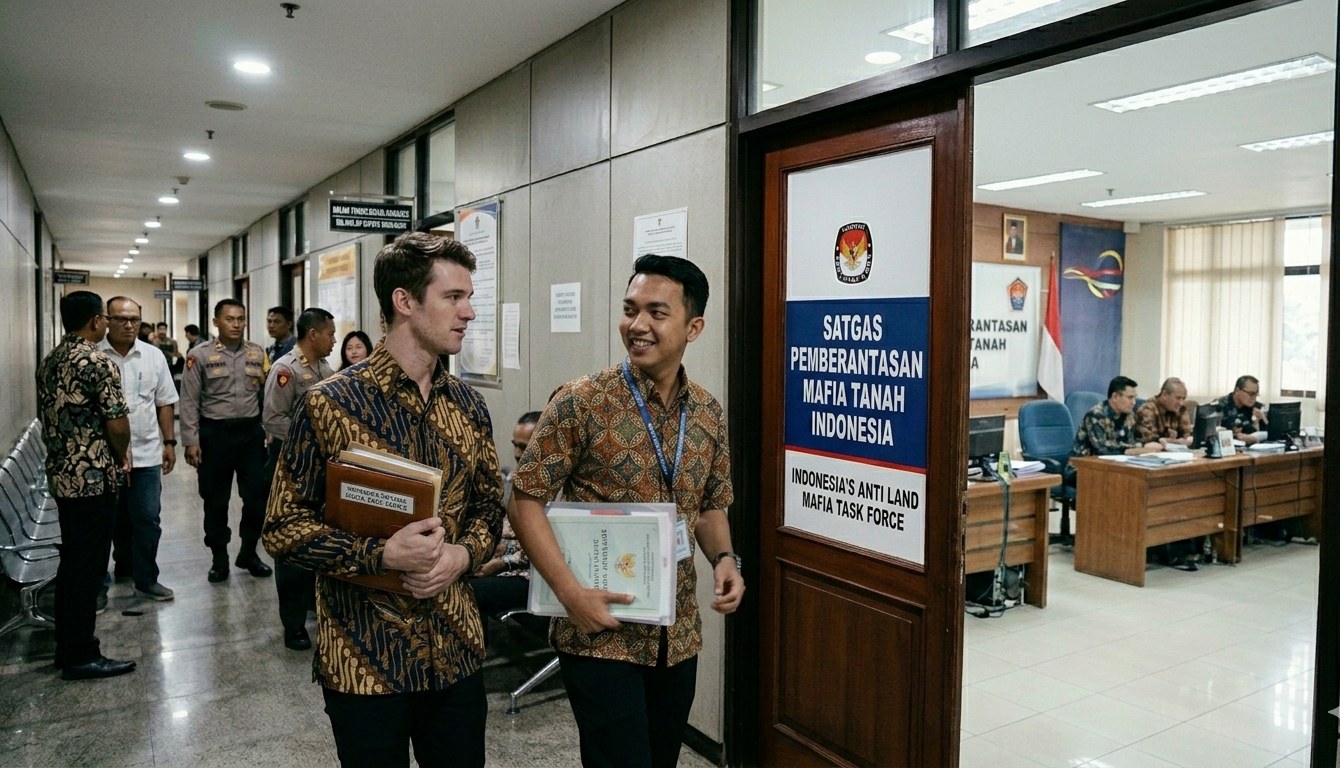
What the New Anti-Land Mafia Task Force Could Mean for Investors and Property Holders
Written by : Terje. H Nilsen
Indonesia’s land sector has long carried a difficult reality: even where documents look complete on paper, underlying disputes, overlapping claims, procedural errors, and organized manipulation can still create serious risk.
Now, that risk environment may be shifting again. The government is preparing a new draft regulation that would replace Minister of Agrarian Affairs and Spatial Planning/National Land Agency Regulation No. 21 of 2020 on the handling and settlement of land cases.
While the earlier regulation already provided the framework for resolving land disputes, conflicts, and cases, the draft goes further in one important direction: it introduces a more direct mechanism for dealing with organized land crime, often referred to as “land mafia” activity.
For investors, developers, land holders, and businesses operating in Indonesia’s property sector, this is more than a technical legal update. It signals a tougher enforcement posture and a stronger willingness by the state to coordinate across institutions when land issues appear structured, intentional, and criminal in nature.
A More Aggressive Approach to Land Crime
One of the most notable features of the draft regulation is the formal inclusion of Land Mafia Cases within the broader land case framework. These are described as land-sector crimes committed in a planned, structured, and organized manner, and subject to criminal penalties.
To address this, the government plans to establish a Land Mafia Task Force at both central and regional levels. This task force would involve elements from:
▪ the Ministry of Agrarian Affairs and Spatial Planning / National Land Agency,
▪ the Indonesian National Police, and
▪ the Indonesian Public Prosecutor’s Office.
That inter-agency structure matters.
It suggests the state is no longer looking at certain land cases as purely administrative or civil matters, but as issues that may require a coordinated enforcement response. For businesses, this raises the bar on what constitutes acceptable land risk management.
A weak file, an unclear chain of title, or unresolved inconsistencies may no longer just delay a transaction — they may draw deeper scrutiny if patterns suggest something more systematic.
The draft also states that if there are indications that Ministry staff or regional land office employees are involved in Land Mafia Cases, the task force may recommend follow-up through the Ministry’s internal supervisory apparatus.
In practical terms, this points to a broader clean-up effort: not only against outside actors, but also against possible internal facilitation.
Why This Matters for the Market
For many property players, especially in high-growth areas, land risk has often been treated as something manageable through relationships, local comfort, or informal assurances. But Indonesia is clearly moving toward a more institutional, evidence-based, and enforcement-driven environment.
That means businesses should think less in terms of “can we make this work?” and more in terms of “can this stand up to scrutiny later?”
This is especially relevant for:
▪ developers assembling land,
▪ investors entering joint ventures,
▪ foreign-backed structures relying on long-term leasehold arrangements,
▪ companies acquiring land through layered ownership histories, and
▪ hospitality or commercial projects where land certainty is essential to licensing, financing, and exit value.
A stronger anti-land mafia framework does not automatically make land transactions more difficult. In many ways, it should improve the market over time. But in the short to medium term, it will likely expose weak structures, poor due diligence, and legacy issues that some parties have been willing to ignore.
Clearer Procedures for Moderate and Minor Land Cases
The draft regulation also appears designed to improve efficiency. Under the current 2020 regulation, land disputes and conflicts generally move through seven phases, including case study, initial presentation, investigation, publication of investigation results, coordination meetings, final presentation, and settlement.
The new draft clarifies that moderate and minor disputes may move through a shorter process, skipping some of the more extensive stages. This may sound procedural, but it is significant.
For businesses involved in genuine land disputes that are less complex or less severe, a clearer distinction between major, moderate, and minor cases could reduce uncertainty and shorten timelines. It may also create a more predictable pathway for resolution where the facts are clearer and the stakes are lower.
That said, procedural simplification does not mean lower risk. It simply means the government is trying to create a more workable framework for handling the large range of land cases it faces.

Reopening Cases if New Evidence Emerges
Another important point in the draft is the treatment of reassessments. Under the previous framework, once a land case reached a K1 completion status — meaning it was considered fully resolved with a final decision such as cancellation, reconciliation, or rejection — it could not be processed further.
The draft regulation appears to soften that position. It would allow land cases to be reassessed if new and decisive documents or data are discovered that were not previously available. However, cases that have already been officially declared resolved would still not be reopened.
This is a meaningful shift. It reflects an acknowledgment that land records, evidence, and relevant facts do not always surface at the same time — particularly in Indonesia, where historical documentation, overlapping rights, and administrative inconsistencies remain common in some areas.
For investors, this means one thing very clearly: a file that looks settled may still deserve deeper review if there are signs that important evidence was missing, overlooked, or never properly tested.
What Businesses Should Do Now
This draft regulation is not just for litigators or parties already in dispute. It is also highly relevant for any business that holds, acquires, develops, or depends on land. A sensible response now would include:
First, revisit due diligence standards.
Do not rely only on certificates or surface-level checks. Review chain of title, underlying rights, historical transfers, boundaries, access, zoning consistency, and the quality of all supporting documentation.
Second, identify legacy risk.
Existing land banks, long-held sites, and projects acquired through multiple parties should be reviewed again, especially where documentation was assembled years ago or through informal market practices.
Third, stress-test transaction structures.
If ownership, control, operation, and licensing are split between several entities or individuals, make sure the structure is coherent and defensible.
Fourth, monitor regulatory developments.
The draft regulation is still under deliberation, and businesses in the land and property sector should keep track of how it evolves, especially ahead of the consultation deadline referenced in the source material.
The Bigger Message
The broader message here is familiar: Indonesia is continuing its move away from tolerance of weak paper compliance and toward greater inter-agency enforcement.
In land matters, that is likely to be welcomed by serious investors. A cleaner system, stronger coordination, and a tougher stance on organized land crime should improve trust in the market over time. But it also means that businesses can no longer afford to be casual about land risk.
In today’s environment, good land due diligence is not just about avoiding disputes. It is about protecting asset value, preserving operational certainty, and making sure a project can survive regulatory or legal scrutiny later.
How Seven Stones Indonesia Can Help
At Seven Stones Indonesia, we see land due diligence as one of the most important parts of any investment strategy in Indonesia.
Whether you are acquiring land, reviewing an existing holding, entering a development partnership, or trying to understand the exposure around a disputed site, the key is to move beyond surface documents and assess the real legal and practical position.
We assist clients by reviewing land structures, identifying hidden risk, coordinating with relevant professionals, and helping ensure that property decisions are built on a stronger legal and operational foundation.
In a market where enforcement is becoming sharper and systems are becoming more connected, structure matters more than ever.