



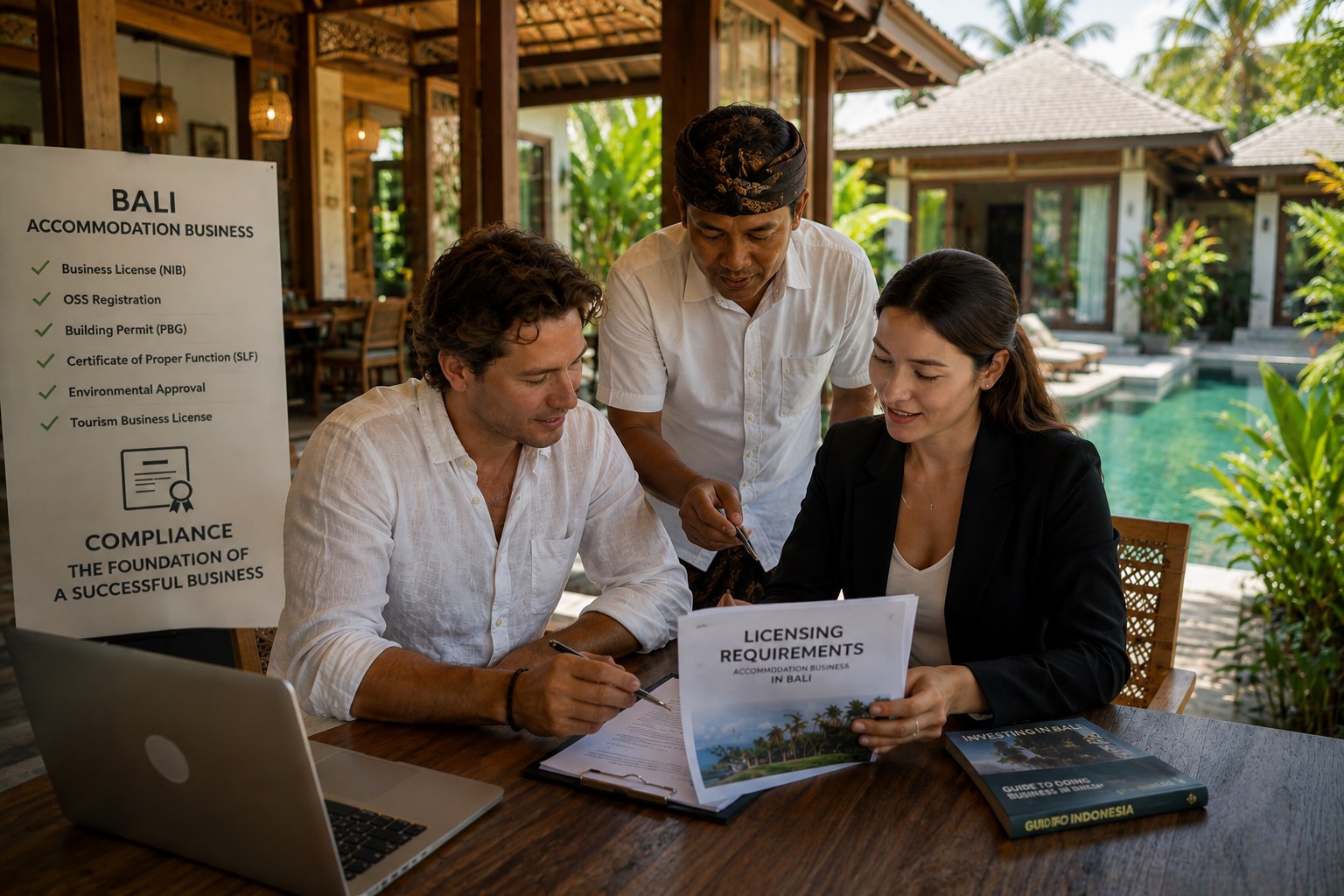
Starting an accommodation business in Bali usually begins with exciting conversations about rental yields, occupancy rates, and beautiful properties. Those are the reasons many investors fall in love with Bali in the first place.
Less frequently discussed is everything that happens before opening day. Business licensing, zoning compliance, and legal permits are equally important, and recent discussions within Bali’s tourism industry show exactly why.
Starting an Accommodation Business in Bali Comes with Licensing Challenges
Recent concerns raised by Bali’s tourism industry have highlighted just how challenging the licensing process can be to establish a tourism accommodation business.
The Bali chapter of the Indonesian Hotel and Restaurant Association recently explained that obtaining accommodation business permits often involves overlapping requirements between the central government, provincial authorities, and local governments.
Operators often need to complete registrations through the Online Single Submission (OSS) system while also meeting additional licensing and regional regulatory requirements before opening their business.
According to Perry Markus, Secretary General of the association, the process is not only complicated but also costly.
“Besides being complicated, obtaining permits is also expensive. Just managing the PBG and SLF requires billions, so people are reluctant to apply for permits,” Perry explained, as quoted on Wednesday (July 1, 2026).
Perry added that simplifying the licensing process is also in line with the principles of sustainable tourism.
“Ease of licensing that is certain, fast, and transparent will encourage investment, create jobs, and increase the competitiveness of Balinese tourism,” Perry added.
What Does Starting an Accommodation Business in Bali Actually Require?
For future investors, the message is clear: licensing shouldn’t be treated as the final step. It should be part of the investment strategy from the very beginning.
Although every project is different, most accommodation businesses—whether villas, boutique hotels, guesthouses, or resorts—must first determine the appropriate Indonesian Standard Industrial Classification (KBLI 2025) for their business activities.
The selected KBLI determines the applicable business classification, risk level, and licensing requirements under Indonesia’s risk-based licensing system. Once the appropriate KBLI has been identified, the licensing process generally follows three stages.
1. Basic Requirements (Persyaratan Dasar)
These confirm that the property is suitable for the intended business activity. Depending on the project, they may include:
▪️ Spatial Planning Conformity (KKPR), where applicable
▪️ Environmental Approval (Persetujuan Lingkungan)
▪️ Building Construction Approval (PBG)
▪️ Certificate of Proper Function (SLF)
2. Business Licensing (Perizinan Berusaha)
After the basic requirements have been fulfilled, the business can obtain its primary business license through the OSS system. Depending on the selected KBLI and business risk level, this may include:
▪️ Business Identification Number (NIB)
▪️ Standard Certificate and/or Business License, depending on the applicable risk classification
3. Supporting Business Licenses (PB UMKU)
Some accommodation businesses may also require additional sector-specific licenses before operating. These supporting licenses depend on the selected KBLI, the nature of the business activities, and the applicable tourism regulations.
Why Licensing Should Be Part of Your Investment Strategy
Property location, design, and projected rental returns often receive the most attention during the investment process. However, licensing requirements can determine whether an accommodation business can legally operate as planned.
Addressing compliance from the beginning is often simpler—and more cost-effective—than resolving licensing issues after construction or renovation is complete. Proper planning can also provide several long-term advantages, including:
✔ Reducing costly project delays by identifying licensing requirements before construction or operations begin.
✔ Supporting smoother business operations by ensuring the necessary permits are in place before welcoming guests.
✔ Avoiding unnecessary revisions and additional costs caused by zoning or compliance issues discovered later.
✔ Increasing confidence for investors and business partners through a legally compliant business structure.
✔ Building a stronger foundation for long-term growth, making future expansion, financing, or business transfers more straightforward.
Start an Accommodation Business in Bali with Seven Stones Indonesia
Whether developing a private villa, boutique resort, or hospitality project, early preparation can make the investment journey far more efficient.
At Seven Stones Indonesia, our multidisciplinary team assists investors throughout every stage of the process, including:
✔ Property sourcing and legal due diligence.
✔ PT PMA establishment and business licensing.
✔ Zoning verification and permit assistance.
✔ Investor, Working, and Dependent KITAS applications.
Reach out today to our legal team to schedule a complimentary 30-minute consultation via Whatsapp. Let’s discover how the right preparation today can help avoid unnecessary complications tomorrow.