




Written by: Terje. H Nilsen
In most real estate markets around the world, the process is fairly straightforward. A buyer finds a property, completes legal due diligence, signs a contract, and takes possession. In Bali, things are a little different.
Here, property exists within a living cultural landscape shaped by centuries of tradition, religious practice, and community structures. Land is not viewed purely as a commercial asset. It is part of a broader relationship between people, nature, and the spiritual world.
For foreign investors and homeowners entering Bali’s property market, understanding this dimension is not only respectful — it is practical. Cultural awareness often plays a significant role in how smoothly a project develops and how well it integrates into the surrounding community.
A Cultural Landscape, Not Just a Property Market
Bali’s society is deeply influenced by the philosophy of Tri Hita Karana, which translates roughly to “the three causes of well-being.” The concept emphasizes balance between three relationships:
▪ Humans and the divine
▪ Humans and nature
▪ Humans and other humans
This philosophy shapes everything from architecture to land use and community organization. It is one of the reasons Bali maintains such a strong cultural identity despite decades of tourism development.
For property owners and developers, it also means that land is rarely treated as a purely technical or economic matter. Cultural traditions remain woven into everyday life.
The Role of Desa Adat and the Banjar
Two key institutions influence how communities function across Bali.
The first is the Desa Adat, or customary village authority. These traditional governance structures exist alongside Indonesia’s formal administrative system and oversee many cultural and religious aspects of community life.
Within each village, residents are organized into smaller neighborhood groups known as banjar. The banjar plays a central role in social life, organizing ceremonies, coordinating community activities, and maintaining local traditions.
While foreign property owners are governed primarily by Indonesian law, developments often exist within areas where banjar communities remain active and influential. Good relationships with local communities therefore become an important part of successful long-term investment.
Ceremonies Connected to Land and Buildings
One of the aspects that surprises many foreign buyers is how often ceremonies are connected to land, construction, and buildings.
These ceremonies are not legal requirements under Indonesian law. However, they remain an important part of Balinese culture and are widely practiced throughout the island. Several ceremonies are commonly associated with property development.
Melaspas – Purification of a New Building
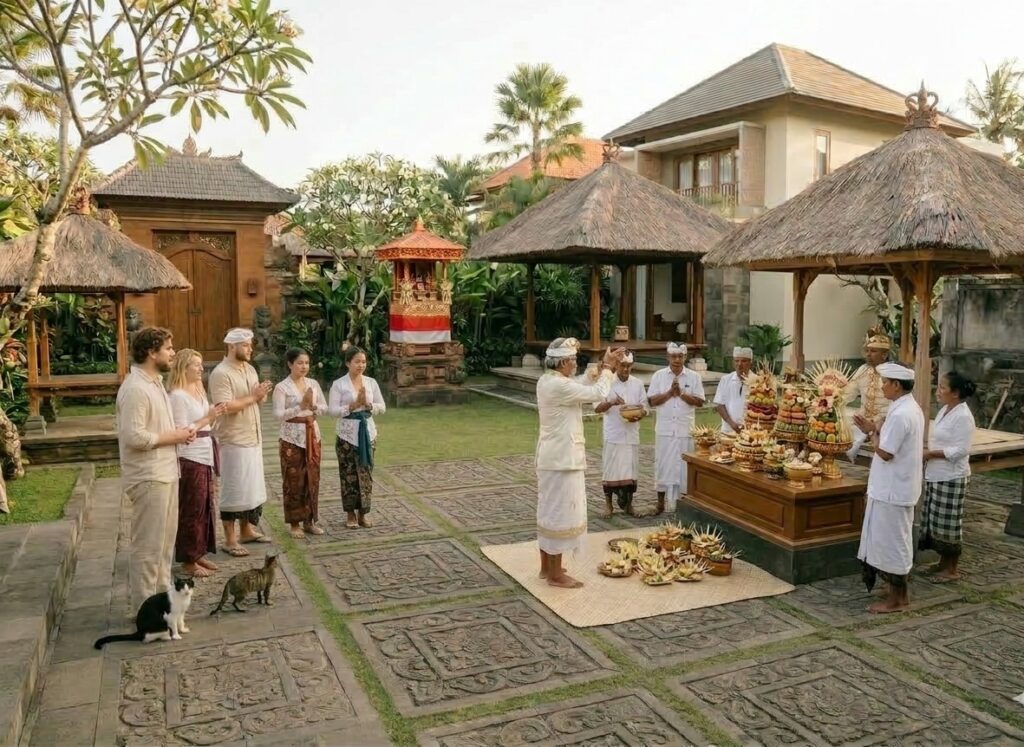
One of the most widely recognized ceremonies is Melaspas, a ritual performed after a building is completed but before it is occupied.
The ceremony symbolically purifies the structure and harmonizes the building with its surroundings. Priests conduct prayers and offerings are made to invite positive energy into the space.
Many villa owners and developers perform Melaspas ceremonies before opening a property for residential use, hospitality operations, or commercial activity.
Mecaru – Restoring Balance with the Land
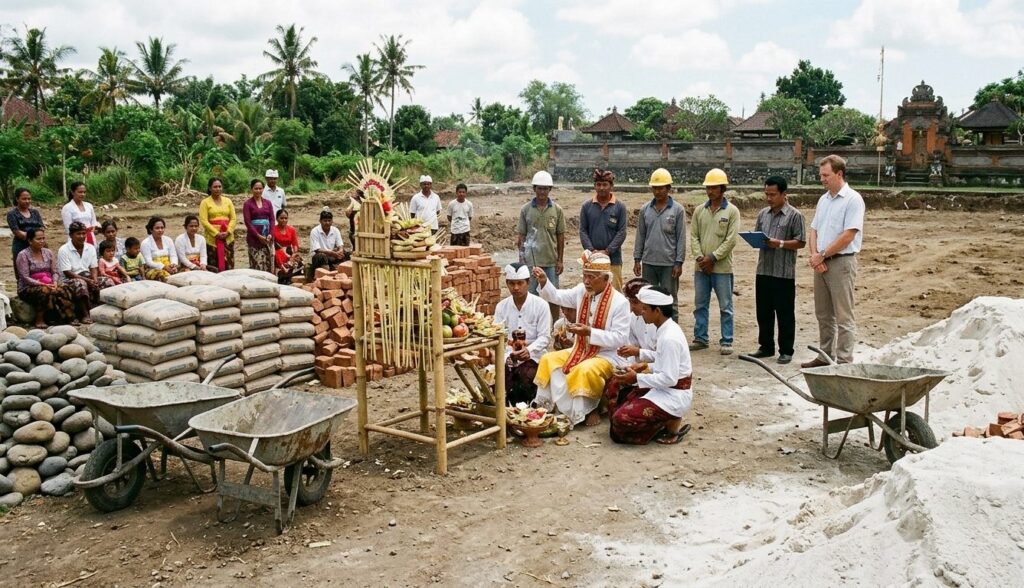
Another ceremony sometimes conducted before construction begins is Mecaru. This ritual is intended to restore balance between human activity and the natural environment. Offerings are made to acknowledge the spiritual forces believed to inhabit the land.
For larger developments, Mecaru ceremonies may be organized before ground is broken as a way of symbolically asking permission to begin construction.
Groundbreaking Rituals
It is also common for a priest to perform a blessing at the start of construction. These ceremonies vary in scale but typically involve offerings and prayers intended to ensure that construction proceeds safely and harmoniously.
Many developers schedule these ceremonies at the beginning of a project, particularly for villas, resorts, and hospitality properties.
The Importance of Temples and Sacred Space
Balinese architecture is traditionally influenced by spatial concepts rooted in religion and cosmology. Many Balinese family homes include a sanggah or merajan, a small family temple located within the property compound. Larger developments sometimes incorporate communal shrines or temple structures as part of the design.
Architectural principles such as Asta Kosala Kosali, a traditional Balinese spatial guideline similar in some ways to feng shui, can also influence building orientation, entrances, and the positioning of structures within a compound.
While foreign-owned villas do not necessarily need to follow these traditions, developments that incorporate elements of Balinese spatial philosophy often resonate more strongly with both local communities and visitors seeking an authentic cultural experience.
When Foreign Buyers Are Surprised
For those unfamiliar with Balinese traditions, cultural practices occasionally come as a surprise. Processions may pass along roads during temple festivals. Ceremonies can take place within neighboring compounds. Streets may temporarily close during major religious events.
Construction timelines sometimes adjust around ceremonial dates, and developments located within traditional communities may encounter moments when cultural activities take priority.
These moments are not disruptions to daily life in Bali — they are part of the island’s rhythm. Understanding this rhythm helps investors and property owners navigate the environment more comfortably.
Cultural Alignment Can Add Value
Interestingly, developments that respect Balinese cultural context often perform well in the market.
Travelers increasingly seek authentic experiences rather than generic destinations. Properties that reflect local architecture, incorporate traditional design elements, or engage respectfully with surrounding communities tend to resonate strongly with guests.
Across Bali, a growing number of developments are blending sustainability, nature-based living, and cultural design principles. Areas such as Tabanan, for example, are emerging as destinations for eco-conscious resorts and nature-oriented villas that integrate more deeply with the surrounding landscape.
Projects like these reflect a broader shift toward quality-driven development — where design, environmental responsibility, and cultural respect become part of the investment value.
Legal Structure Still Matters
Of course, cultural awareness does not replace legal compliance. Foreign investors must still navigate Indonesia’s formal regulatory framework governing property ownership, zoning, licensing, and operational permits.
Ensuring proper land title structures, confirming zoning compatibility, verifying access rights, and understanding operational licensing remain critical parts of any investment decision. Successful developments in Bali usually combine two things:
▪ Strong legal and regulatory structure
▪ Respect for local cultural context
When these elements align, projects tend to integrate more smoothly into the local environment and operate with greater long-term stability.
How Seven Stones Helps Investors Navigate Bali
At Seven Stones Indonesia, we often explain to investors that understanding Bali requires looking at both sides of the equation. On one side is the legal framework — land certificates, zoning regulations, licensing requirements, and ownership structures.
On the other side is the cultural landscape — community dynamics, traditional practices, and the rhythms of Balinese life.
Navigating both dimensions helps investors make informed decisions while building developments that integrate respectfully with the island’s unique character.
Bali remains one of the world’s most distinctive destinations. For those willing to understand how its traditions intersect with modern development, it offers opportunities that extend far beyond the typical property market.